AI voice cloning laws in 2026: what changed this year, and what it means for your own voice
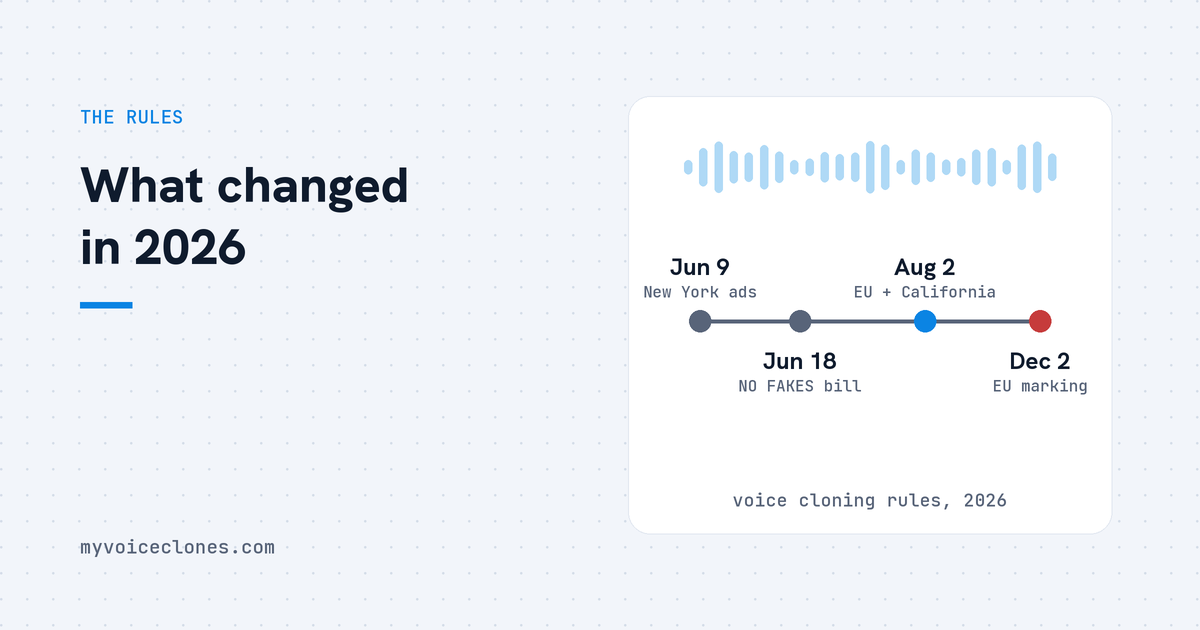
Four voice cloning rules moved in 2026. The EU AI Act started its labeling rules for AI made audio on 2 August 2026, and it gave tools already on the market a grace period to 2 December 2026 for hidden marking. California's AI Transparency Act started the same day for AI services with more than one million monthly users, and New York's AI ad disclosure law started on 9 June 2026. The federal NO FAKES Act passed a Senate committee on 18 June 2026 but is not law yet, and cloning your own voice is still legal.
| Rule | Where | Started | Who it binds | What it means if you clone your own voice |
|---|---|---|---|---|
| EU AI Act, Article 50 | European Union | 2 August 2026 | AI providers, and people who publish AI content as part of their work | Label realistic AI audio when you publish it for work |
| EU AI Act, hidden marking | European Union | 2 December 2026 for tools already on the market | The companies that make the AI tools | Nothing for you to do, it is the tool maker's job |
| California AI Transparency Act (SB 942) | California | 2 August 2026 | AI services with more than 1 million monthly users | Nothing for you to do |
| New York synthetic performer law | New York | 9 June 2026 | Businesses that make ads | Disclose an AI made performer in an ad you produce |
| NO FAKES Act (S. 4591) | United States | Not law yet, passed the Senate Judiciary Committee on 18 June 2026 | Anyone who makes or shares a digital replica without permission | Nothing changes for your own voice |
By Inam. I build VoiceClone, a Windows app that clones a voice on your own machine, so I follow these rules for my own product and not only for this page. My other engineering write ups are at designesh.com. Last updated 24 September 2026.
You might use an AI cloned voice, or you might be thinking about it. You have probably seen headlines saying 2026 is the year voice cloning got regulated, and that makes the technology sound risky. It actually did not become risky. Cloning your own voice is still legal everywhere I know of, and cloning a voice with its owner's clear permission is fine too.
Two other things changed instead. The first thing is labeling. In Europe, and in some American ads, you now have to mark AI made audio that sounds real as AI when you publish it. The second thing is ownership, and the United States is getting closer to a federal law that treats your voice as something you own, just like states like Tennessee already do.
If you clone your own voice and publish it for work, you should label it as AI. That is the single habit that keeps you safe under every rule below.
Which rules actually changed in 2026?
I put five things in the table above, and they are easy to mix up since they all arrived in the same few months. They actually bind different people. Two of them apply to the companies that build AI tools, and one applies to advertisers. One binds anyone who publishes realistic AI content, and the last one is still a bill.
That difference is the whole story if you are a normal creator. A rule for "providers" applies to the company that made the software. A rule for "deployers" applies to the person who uses the software and publishes the result. You are probably a deployer, so only one of these rules really asks something of you.
What does the EU AI Act require for AI voices?
Europe has a big AI law called the EU AI Act, and the part that matters here is Article 50, the transparency rules. The European Commission states on its own page that Article 50 applies from 2 August 2026. This article has two halves, and they land on different groups of people.
The first half is for the companies making the tools. A company with an AI that makes audio must mark that audio in a machine readable way, which means a hidden signal inside the file that software can detect. Tools already on the market before 2 August 2026 get a grace period for this hidden marking until 2 December 2026. They got this extra time from the EU's Digital Omnibus deal on AI, and that deal was agreed on 7 May 2026.
The second half is for the people who actually publish the audio. If you put out a deepfake, you have to disclose that it is AI. In this law, a deepfake means AI made audio, image or video that resembles a real person and could pass as genuine. The Commission says the disclosure must happen "upon first exposure at the latest", so the listener needs to hear the label at the start and not buried at the end.
Two details make this less scary than it sounds. The duty falls on a "deployer", but the Act excludes someone using AI for a purely personal and non professional activity. For creative, satirical or fictional work, you only have to make the disclosure in a way that does not spoil the work.
I can show you how this works out in practice. You might make a birthday message in your cloned voice for your mother, and that counts as personal use. But if you narrate a monetized YouTube channel in your cloned voice, that is professional use, so you must disclose it in the EU. If you earn money from content that uses your cloned voice, say it is AI made right in the video itself or at the start of the description.
Does California's AI Transparency Act apply to small creators?
California has its own rules. The AI Transparency Act there is called SB 942, and it became operative on 2 August 2026 after a later law called AB 853 moved its start date. This rule binds the companies running generative AI systems with more than one million monthly visitors or users that are publicly accessible in California.
Those companies must now offer a free tool that checks whether content came from their system. They also have to give users the option of a visible AI label, and embed a hidden disclosure with the system's name, version and creation date. I read Morgan Lewis's summary of the law, and it puts the penalty at $5,000 per violation, where each day counts as a separate violation. More steps will follow for large online platforms from 1 January 2027, and then camera and device makers from 1 January 2028.
If you are a creator and not a company running an AI service for over a million people, SB 942 asks nothing of you. I wrote a longer explanation about how this differs from YouTube's own AI label in using your own AI voice for YouTube.
What does New York's AI ad law require?
New York has a synthetic performer law that took effect on 9 June 2026, and Governor Hochul signed it in December 2025. You can read the governor's announcement which describes a synthetic performer as digitally created media that appears as a real person. A business producing an ad must disclose when such a performer is in it.
This rule only matters if you make advertising. A product video for your own small business that uses an AI made presenter is exactly the kind of case it was written for. The penalty in the law is $1,000 for a first violation and $5,000 for each one after that. If you make ads that reach New York and an AI made person appears in them, label the ad.
What is the NO FAKES Act, and is it law yet?
The NO FAKES Act is a federal bill that would give every person in the United States a property right over digital replicas of their voice and their visual likeness. This means your voice would legally belong to you. Making or sharing a realistic AI copy of your voice without your permission would become something you could sue over. The current version is S. 4591, and they call it the NO FAKES Act of 2026.
This bill is not law yet. The Senate Judiciary Committee's results for 18 June 2026 show they reported it favorably by voice vote, and they adopted a managers' amendment. A bill that clears committee still needs a vote in the full Senate, a vote in the House and a signature before it counts. I could not find proof that any of those final steps have happened.
Some states already have this protection. Tennessee's ELVIS Act, signed on 21 March 2024, added "voice" to the personal rights the state protects, aimed exactly at AI copies. The federal bill would put a similar right into law nationwide.
None of this changes anything for your own voice, since you are already the owner. It really matters when you plan to use someone else's voice. If it is not your voice, get the owner's permission in writing before you clone it, even if the law where you live does not demand it yet.
Did anything change in the rest of Europe?
Denmark tried to go further than anyone else by proposing a copyright style right over your own face and voice. This meant an AI copy made without consent could be taken down just like a pirated film. The European Commission pushed back in March 2026, arguing that copyright does not protect a voice, which you can see in ICTRecht's write up of the Commission's response. I could not confirm that the Danish proposal became law, so treat it as a proposal for now.
Everywhere else, the older rules still do the real work. Using a cloned voice for fraud was already a crime before any of these new bills. In the United States, the FCC ruled in February 2024 that AI generated voices in robocalls count as artificial voices under the Telephone Consumer Protection Act. I cover that older ground and the consent question in my article on is voice cloning legal.
So what should you actually do?
I tell people to keep it simple, because the rules point the same way even when they come from different places. Cloning your own voice for your own work is perfectly fine. Publishing it for work simply means labeling it as AI, and that is already the law in the EU and good practice everywhere else.
When I narrate with my own clone, I say so in the description and it has never cost me a single viewer. This label also protects you from people calling your real recordings fake, which is a problem I wrote about in can you detect a cloned voice. That happens more often now. Clone your own voice freely, get written permission for anyone else's, and label what you publish.
FAQ
Is voice cloning legal in 2026?
Yes, cloning your own voice is legal, and cloning a voice with its owner's clear permission is legal too. The year 2026 added labeling rules for publishing realistic AI audio, mainly in the EU starting from 2 August 2026. Using a cloned voice for fraud or impersonation was already a crime, and it still is today.
Do I have to label my own cloned voice under the EU AI Act?
Yes, if you publish it as part of your work, you should disclose that it is AI made. The Act does not treat purely personal and non professional use as a deployer, so a private message to your family is totally outside the rule. If you make creative or fictional work, the label just has to be done in a way that does not spoil the work.
Has the NO FAKES Act passed?
No, it has not passed yet. The Senate Judiciary Committee advanced S. 4591 by voice vote on 18 June 2026, but it still needs a full Senate vote, a House vote and a signature to become law. Tennessee already protects voice at the state level with the ELVIS Act.
Does California's SB 942 apply to me?
It only applies if you run a generative AI service with more than one million monthly users that is publicly accessible in California. The law became operative on 2 August 2026 and binds those specific companies. It does not bind the normal creators who just use their tools.
Sources: the European Commission's page on transparency obligations under Article 50 of the AI Act, the Senate Judiciary Committee's results of its 18 June 2026 executive business meeting, Morgan Lewis on the California AI Transparency Act becoming operative, Governor Hochul's announcement of the New York synthetic performer law, the Tennessee governor's page on signing the ELVIS Act, William Fry on the EU Digital Omnibus agreement of 7 May 2026, ICTRecht on the European Commission's response to Denmark's proposal, and the FCC's February 2024 declaratory ruling on AI voices in robocalls. I read all of them on 24 September 2026.
Hear your own voice come back.
The free Windows app clones and fully trains one voice, yours, on your own PC. No account, no upload, and the download starts right away.