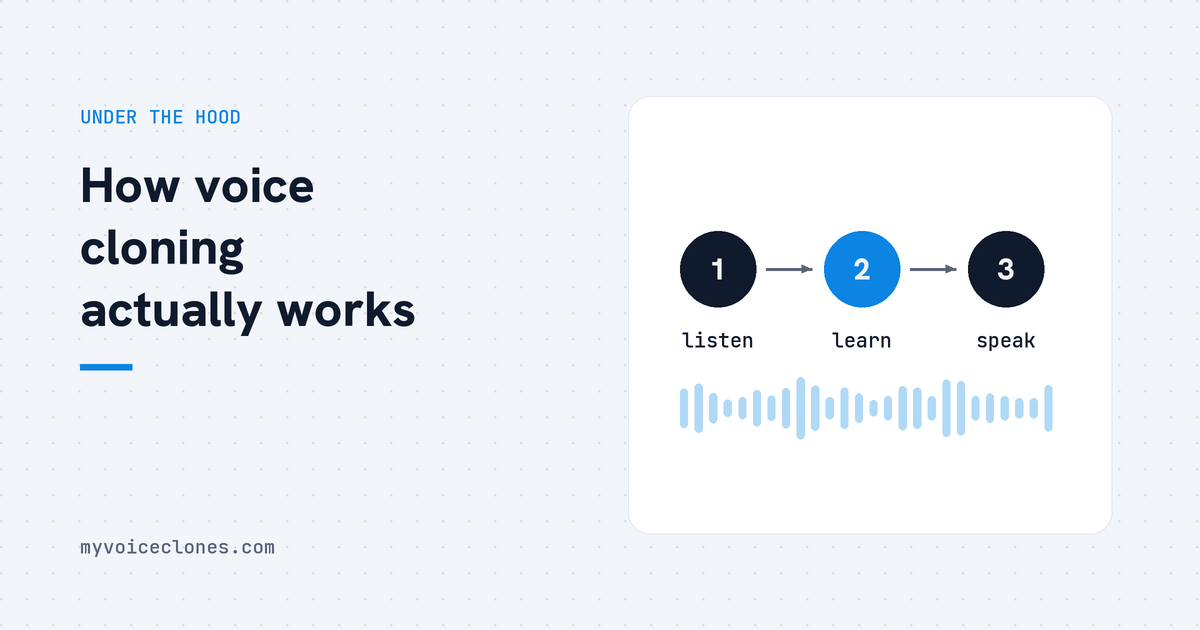
Voice cloning works in two parts: the software turns a short recording into a voice fingerprint, a set of numbers describing how you sound, and a speech model already trained on thousands of hours of human talk then speaks any text while wearing that fingerprint. It needs only a minute of you because it is not learning speech from you, only learning you from you.
My brother's reaction to my cloned voice was not the fun kind of amazement, it was suspicion. He made me play it four times, then asked the question that this whole article answers: "it heard you for one minute, how can it learn your whole voice from one minute?" And I loved the question, because it contains a completely reasonable wrong assumption, the same one I had before building a voice tool, that the software learns to speak by studying you.
It does not. It already knew how to speak. It only learns you from you, and once that clicks, everything else about voice cloning, what it needs, where it fails, why training helps, becomes almost obvious. So here is the whole machine, explained the way I explained it to him, no math required.
What is a voice fingerprint?
When you give a voice cloner your recording, it does not keep your audio the way a sampler keeps a drum sound. It listens once and produces a voice fingerprint, a compact list of numbers describing HOW you sound: where your pitch naturally sits, how your vowels are shaped, the texture of your voice, the small habits that make a phone caller recognizable in one word.
A useful way to picture it is how police sketch software describes a face, not as a photo but as measurements, eye spacing, jaw width, nose length. Enough measurements and the description becomes uniquely you without containing a single photograph. Your voice fingerprint is that, for sound. This is also why a minute of audio is enough, because measuring how a voice sits does not take long, the same way you recognize an old friend's voice from one "hello" on a bad phone line.
Engineers call this a speaker embedding, which is just their name for that list of numbers, and it is not a secret you have to take on faith. The engine my own app runs on is open source, so you can read the step that builds it in the GPT-SoVITS source code before it generates a single sound, and there is a plain words explanation of GPT-SoVITS if the name on its own is off-putting.
Where did the AI learn to speak?
The second part is the actual talker, a model trained beforehand on thousands of hours of many different people speaking. From all that listening it learned how human speech works in general, how sentences rise and fall, where breaths go, how a question curls at the end, how letters become mouth sounds. It learned to speak the way you learned to speak, by absorbing years of other people doing it.
Cloning is these two parts shaking hands. The speech brain says the sentence, and your fingerprint tells it which throat to wear while saying it. The knowledge of speech comes from the model's long education, and only the identity comes from your minute. My brother's question, answered: it did not learn my voice in a minute, it spent the equivalent of years learning voices, and then took one minute of measurements of mine.
What is the difference between an instant clone and a trained clone?
Everything above describes an instant clone, and you can probably already smell its limit: the speech brain is wearing you like a costume, and a costume misses details. It captures the broad identity and smooths over the tiny habits, which is why instant clones of my voice measure around 80 percent similar to me, convincing to strangers, slightly off to my own ears.
Training goes one level deeper. Instead of just handing the model your fingerprint, training adjusts the model's own internal wiring using your recordings, so your voice stops being a costume and becomes part of the tailor. That is the jump from 80ish to about 96 percent on my own measurements, and it is the single biggest quality difference in this whole field.
Here are the two side by side, with the numbers I measured on my own voice and my own machine.
| Instant clone | Trained clone | |
|---|---|---|
| What you give it | 1 to 3 minutes of clean audio | 5 to 10 minutes, across two or three sittings |
| What it does with your voice | Wears your fingerprint like a costume | Rewires the model itself around your voice |
| Wait before you hear it | Under a minute | Under an hour on a normal NVIDIA card, about 145 minutes on a small 4 GB laptop card |
| How close it sounded to me | About 80 percent | About 96 percent |
| Who it convinces | Strangers, easily | People who know your voice well |
Why does every take come out different?
One more gear, and it explains the most confusing behavior. When the model speaks, it does not calculate the one correct way to say your sentence, because no such thing exists, humans never say a sentence identically twice. Instead it makes weighted choices sound by sound, a controlled dice roll, which is what makes the result feel alive rather than robotic.
The cost of the dice is that occasionally a word comes out mangled, and the model has no idea, because it does not listen to itself. The same text can generate perfect and garbled one minute apart. This is not a bug in your tool, it is the nature of the machine, and it is why I built VoiceClone to generate several takes, transcribe each with a speech recognizer, and grade every word before showing me the best one. The dice stay, somebody just finally checks them.
What can voice cloning still not do?
Honest limits, because the machine has them. It reproduces what the fingerprint captured, so noise in your recording becomes noise in your clone, faithfully. It speaks, it does not sing, the timing world of melody is a different machine. Emotion follows the text's cues approximately, it acts the sentence, it does not feel your Tuesday. And a clone is frozen the day you make it, it will not age with you, which sounds philosophical until you realize you can simply record a new minute next year.
None of these stop the real uses, narration, videos, audiobooks. They just mark the edge of the map honestly.
FAQ
How does voice cloning work in simple terms?
The software measures a short recording into a voice fingerprint, numbers describing how you sound, and a speech model trained on thousands of hours of human talk then speaks any text wearing that fingerprint.
Why does it need so little audio?
Because it is not learning to speak from your recording, it already knows speech. It only needs long enough to measure your voice's identity, and a clean minute covers that.
Is the clone remixing pieces of my recording?
No. It generates every sound fresh from the fingerprint, which is why it can say words that never appear in your recording, including ones you never say.
Why do AI voices sometimes garble a word?
Generation makes weighted random choices to sound alive, and occasionally a choice lands wrong. Tools that verify their own output catch this, tools that give one blind take make you catch it.
How can you hear the handshake yourself?
Reading about the fingerprint is one thing, hearing it get measured is another. The free VoiceClone app runs this whole machine on your own PC, nothing uploaded, and turns your minute into a talking you while you watch. Do it once and my brother's four replays will make complete sense.
Hear your own voice come back.
The free Windows app clones and fully trains one voice, yours, on your own PC. No account, no upload, and the download starts right away.